
AWS Certified Database - Specialty Beta Exam - Tips and Tricks

Diwa “Wawi” del Mundo
Founder & President · Apper Cloud Labs
The results are out for the beta exam (DB1-C01) of the AWS Certified Database - Specialty, and I’m happy to share that I passed and gained the credential.
The beta exam was difficult. To give you an idea of the difficulty level of the exam, the AWS Certified Database - Specialty is a cross between the Solutions Architect - Professional, SysOps Administrator - Associate, and Security - Specialty except that it is focused on AWS database services.
I relied heavily on the exam guide to determine focus areas. Since it is a beta exam, figuring out the exam coverage is critical. AWS is advocating "purpose-built" databases, which provides a paradigm shift on how architects and developers should look at modern data stores. Here is a good article that discusses purpose-built databases: https://aws.amazon.com/blogs/database/building-a-modern-application-with-purpose-built-aws-databases/
From the article: "The days of one-size-fits-all, monolithic databases are behind us. As Werner Vogels, CTO and VP of Amazon.com,said: “Seldom can one database fit the needs of multiple distinct use cases." In the past, web applications were constructed by using the LAMP stack (Linux, Apache, MySQL, and PHP), where a single database was used for many different experiences.
Based on the article, it provided me a north-star for exam preparation. I booked the exam on the last day of the beta period, but I only started preparation during the last week of December 2019.
I focused my efforts heavily on the following:
- Amazon Aurora
- AWS Database Migration Service (DMS) and AWS Schema Conversation Tool (SCT)
- Amazon Redshift
- Amazon DynamoDB and DynamoDB
- Accelerator
On top of these services, I also spent much time on understanding the use cases of the other purpose-built database services:
- Amazon Neptune (Graph)
- Amazon QLDB (Ledger)
- Amazon DocumentDB (Document database with MongoDB compatibility)
- Amazon Timestream
I was lucky I have some experience with Amazon Neptune and QLDB. I spent time evaluating QLDB in its preview release, so I have a good idea of its use cases and limitations.
Exam Domains
The exam has five domains. I didn’t focus too much on Domains 4 and 5 for my preparation since I have good experience already for managing, monitoring, and securing AWS workloads. I also have the AWS Certified Security - Specialty and AWS Certified DevOps Engineer - Professional, so I have a hunch that the questions would be similar to those two certification exams.
I compiled a list of the whitepapers I used for my preparation:
- Migrating Applications Running Relational Databases to AWS Best Practices Guide
- Modernizing the Amazon Database Infrastructure Migrating from Oracle to AWS
- Database Caching Strategies Using Redis
- Amazon RDS for Aurora Export/Import Performance Best Practices
- Amazon Aurora Migration Handbook
As a Specialty exam, I expected that it requires a deep dive into the database services advanced features. I wasn’t disappointed, and that’s what exactly appeared on the exam. If you are preparing for the exam, you must read the product pages, and the developer guides multiple times end-to-end.
I’ll be writing separate articles for each domain to discuss exam preparation details. I hope this article gave you a better idea of what entails to be an AWS database specialist. AWS did a phenomenal job of developing these purpose-built databases, and it is an excellent opportunity to leverage them in building high-performance applications and platforms in the cloud.
Congratulations to those who passed the AWS Certified Database - Specialty!
The results are out for the beta exam (DB1-C01) of the AWS Certified Database - Specialty, and I’m happy to share that I passed and gained the credential.
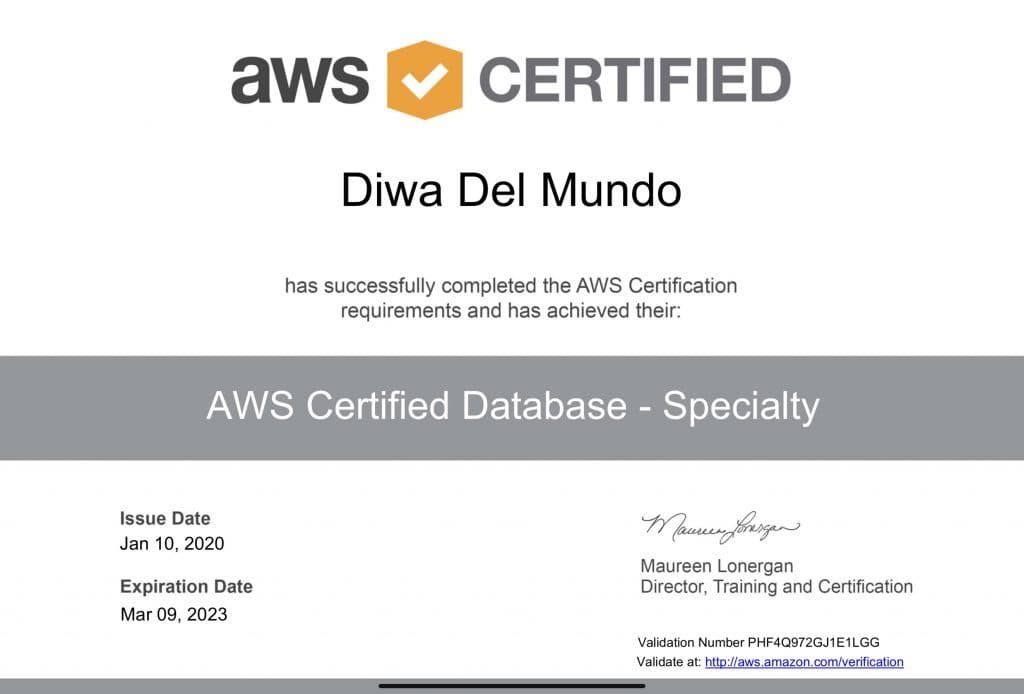
AWS Certified Database - Specialty credential awarded to Diwa del Mundo
The beta exam is difficult. To give you an idea of the difficulty level of the exam, the AWS Certified Database - Specialty is a cross between the Solutions Architect - Professional, SysOps Administrator - Associate, and Security - Specialty except that it is focused on AWS database services.
I relied heavily on the exam guide to determine focus areas. Since it is a beta exam, figuring out the exam coverage is critical. AWS is advocating "purpose-built" databases, which provides a paradigm shift on how architects and developers should look at modern data stores. Here is a good article that discusses purpose-built databases:
From the article: "The days of one-size-fits-all, monolithic databases are behind us. As Werner Vogels, CTO and VP of Amazon.com, said: “Seldom can one database fit the needs of multiple distinct use cases." In the past, web applications were constructed by using the LAMP stack (Linux, Apache, MySQL, and PHP), where a single database was used for many different experiences. "
Based on the article, it provided me a north-star for exam preparation. I booked the exam on the last day of the beta period, but I only started preparation during the last week of December 2019.
I focused my efforts heavily on the following:
AWS Database Migration Service (DMS) and AWS Schema Conversation Tool (SCT)
Amazon DynamoDB and DynamoDB Accelerator
On top of these services, I also spent much time on understanding the use cases of the other purpose-built database services.
Amazon DocumentDB (Document database with MongoDB compatibility)
I was lucky I have some experience with Amazon Neptune and QLDB. I spent time evaluating QLDB in its preview release, so I have a good idea of its use cases and limitations.
The exam has five domains. I didn’t focus too much on Domains 4 and 5 for my preparation since I have good experience already for managing, monitoring, and securing AWS workloads. I also have the AWS Certified Security - Specialty and AWS Certified DevOps Engineer - Professional, so I have a hunch that the questions would be similar to those two certification exams.
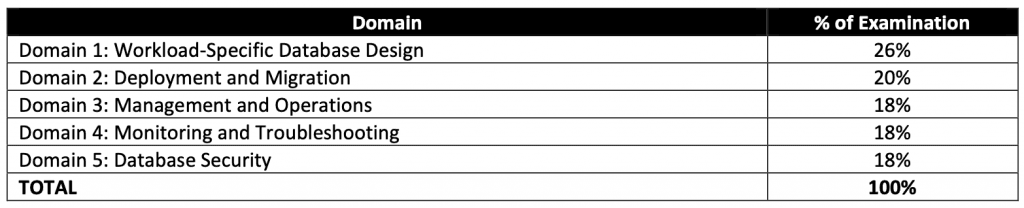
Exam Domains
I compiled a list of the whitepapers I used for my preparation:
Migrating Applications Running Relational Databases to AWS Best Practices Guide
Modernizing the Amazon Database Infrastructure Migrating from Oracle to AWS
Database Caching Strategies Using Redis
Amazon RDS for Aurora Export/Import Performance Best Practices
Amazon Aurora Migration Handbook
As a Specialty exam, I expected that it requires a deep dive into the database services advanced features. I wasn’t disappointed, and that’s what exactly appeared on the exam. If you are preparing for the exam, you must read the product pages, and the developer guides multiple times end-to-end.
I’ll be writing separate articles for each domain to discuss exam preparation details. I hope this article gave you a better idea of what entails to be an AWS database specialist. AWS did a phenomenal job of developing these purpose-built databases, and it is an excellent opportunity to leverage them in building high-performance applications and platforms in the cloud.
AWS Certified Database - Specialty Badge
Congratulations to those who passed the AWS Certified Database - Specialty!
Diwa “Wawi” del Mundo
Founder & President, Apper Cloud Labs
Wawi is a Claude Certified Architect and holds the AWS Certified Generative AI Developer – Professional credential, alongside all 14 AWS certifications, CISSP, and CCSP. He founded Apper Cloud Labs in 2019 and today leads its AI practice, with Claude as the technical center of gravity and cloud infrastructure as the foundation that gets the work into production.